Land Acknowledgments

It’s now fashionable at public events to begin with an indigenous land acknowledgment, usually something along these lines:
The ostensible goal of these acknowledgments is to promote a “greater public consciousness of Native sovereignty and cultural rights.” 1
But strangely, these acknowledgments always seem a bit short-sighted, given that they only acknowledge the previous land occupants. Not the ones before them, or the ones before them, and so on, all the way back to the Clovis People, the first settlers of North America.2
Clovis refers to one of the earliest known prehistoric Native American cultures. One theory is that the Clovis people crossed the Bering Land Bridge from Siberia and moved south through an ice-free corridor into the central U.S., approximately 12,800 years ago. (See also Peopling of the Americas.)
Clovis culture pre-dates our modern-day concept of land ownership, so Clovis land could never have been legally ceded or given freely.
Today, the 574 federally recognized tribes (Cherokee, Choctaw, Sioux, Comanche, Chnook, Inuit, etc.) 3 occupy land that was once home to the Clovis people. This land, in turn, was subsequently appropriated by Spanish explorers, English settlers, and other European colonists.
Given what we know of human nature in general, and Native American populations in particular, it’s likely that `land appropriation’ throughout history (from the Clovis culture thousands of years ago to modern tribes today – even prior to European colonization, circa 1492), was likely violent and unforgiving.
-
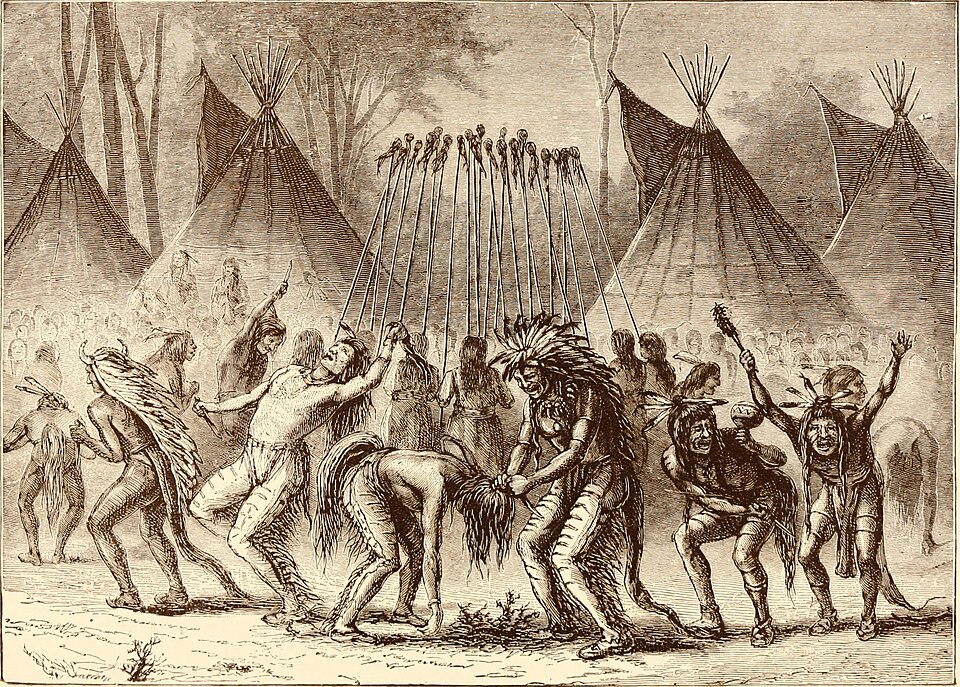
Violence between Native American tribes took many forms. 4
-
War captives were executed in ritual ways, sometimes involving torture, as a form of spiritual justice or communal healing. 5
-
Indigenous slavery existed in some regions even before European contact. 6
-
Scalping occurred both before and after European contact, though colonial powers (like the British and French) later encouraged it with bounties.7 8 9 10 11
-
Raiding was sometimes a way of life, targeting rival tribes or agricultural villages. 12
Of course, not all Native American history was violent. Many tribes maintained long-standing peace with neighbors and used diplomacy, intermarriage, and trade to manage relations. 13
But still, the question remains: How far back do we go when acknowledging “public consciousness of Native sovereignty and cultural rights”?
Today’s Native American tribes haven’t always been here. The ones that are still here undoubtedly displaced previous tribes, even before European colonists came on the scene. 14 15
So it’s a wonder. Do—or did?—Native American tribes do land acknowledgments, too?
Probably not. So why do we do it?
Virtue signaling
We do it because land acknowledgments are a form of virtue signaling. No one really cares about the public consciousness of Native sovereignty and cultural rights. What we care about are the feelings we get when we imply that our invading culture has learned from the past and so now is somehow better than previous invading cultures of the past.16
We do this by conspicuously drawing attention to our occupation of unceded land that was unceremoniously appropriated from indigenous tribes who themselves managed to occupy unceded land from prior indigenous tribes, who in turn managed to occupy ancestral unceded territory from prior previous tribes, and so on and so forth, all the way back to the Clovis people who’s distant ancestors originally came from Africa, for crying out loud. 17 18
So the final thing to ask about land acknowledgments is this: Are we going to give the land back?
No.
Then shut up about it.
-
https://www.neefusa.org/guide-indigenous-land-acknowledgment ↩︎
-
Genus Homo (our direct lineage) emerged in Africa about 23 million years ago. Anatomically modern humans (Homo sapiens) evolved in Africa around 300,000 years ago. All non-African humans descend from later migrations out of Africa. ↩︎
-
The Conversation About American Torture is 400 Years Old – Aeon ↩︎
-
Kehoe, Alice B. North American Indians: A Comprehensive Account. 3rd ed., Pearson, 2005, pp. 236–238. ↩︎
-
Brown, Joseph Epes. The Spiritual Legacy of the American Indian. Crossroad, 1982. ↩︎
-
Calloway, Colin G. First Peoples: A Documentary Survey of American Indian History. 6th ed., Bedford/St. Martin’s, 2019, pp. 122–125. ↩︎
-
Densmore, Frances. Teton Sioux Music and Culture. Originally published 1918. Reprint, University of Nebraska Press, 1992, pp. 107–110. ↩︎
-
Native American Diplomacy and Trade – Encyclopedia Britannica ↩︎
-
Richter, Daniel K. Facing East from Indian Country: A Native History of Early America. Harvard University Press, 2001. Richter discusses the dynamic history of Native groups, including migration, conflict, and the displacement of other Indigenous peoples prior to European contact. ↩︎
-
Richter, Daniel K. Facing East from Indian Country: A Native History of Early America. Harvard University Press, 2001. This book provides a scholarly overview of intertribal relations, Indigenous diplomacy, warfare, and responses to European colonization. ↩︎
-
It is, but not because of land acknowledgments. ↩︎
-
Stringer, Chris. Out of Africa: What the Fossil Record Says. Scientific American, July 2003. This article explains the widely accepted “Out of Africa” theory of human evolution and migration. ↩︎
-
Waters, Michael R., and Thomas W. Stafford Jr. “Redefining the Age of Clovis: Implications for the Peopling of the Americas.” Science, vol. 315, no. 5815, 2007, pp. 1122–1126. DOI:10.1126/science.1137166. This paper provides archaeological evidence for the age and spread of the Clovis culture in North America. ↩︎